U.S. Census Bureau, Center for American Progress
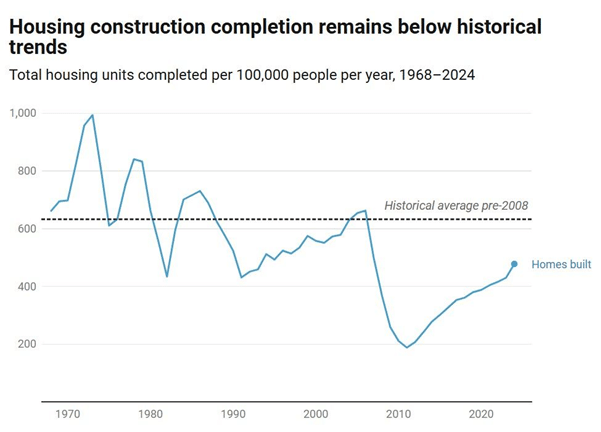
Center for American Progress (CAP) released a new plan to boost federal efforts to build more homes and lower housing costs. Per the chart, housing construction plunged after the Great Recession and remains below historical levels. After years of underbuilding, CAP says sustained, above-average production is needed to rebalance supply and ease the affordability crisis.
The plan outlines policies to accelerate housing construction over the next five years, with three core strategies:
1.Remove Barriers to Building
The plan centralizes on the Rent Relief for Reform (R3) program, a carrot and stick model that identifies cities and counties with housing shortages or extremely high rents, labels them as Housing Cost Crisis Zones (HCCZs), and gives local governments a choice:
- Build the housing and HUD will give all the renters in the city up to $1,000 off their rent; or
- Don’t build the housing and lose access to federal grants.
If a jurisdiction chooses Option 1, HUD would enter into “affordability contracts” with targeted HCCZ jurisdictions, for whom HUD would set housing supply targets based on local shortages, density, growth potential, and other factors, and put in place a plan for addressing them.
2.Build More Affordable Housing at Lower Cost
CAP proposes the following actions to help accelerate production, lower costs, and increase access for factory-built homes:
- Create the Advanced Research Projects Agency-Home (ARPA-Home) program, a government funded program used to purchase modular housing.
- In Context: This initiative builds on Operation Breakthrough (1969–1974), an effort by former HUD Secretary George Romney that demonstrated the potential of modular construction, producing nearly 20,000 units across nine cities.
- Modernize building codes to make building modular easier such as removing an outdated federal requirement to attach a permanent steel chassis to all modular construction.
- Go Deeper: This provision is included in the ROAD to Housing Act which is attached to the National Defense Authorization Act (NDAA).
- Update federal insurance and financing rules to make sure modular production qualifies for coverage.
3.Protect Consumers & Reduce Other Housing Expenses
The final section focuses on ways to reduce other housing costs including:
- Exempt building materials from Trump administration’s tariffs;
- Prevent GSE reforms that would increase mortgage costs;
- Go Deeper: The Trump administration is considering ending Fannie and Freddie’s conservatorship and conducting an initial public offering-like process where investors are invited to purchase shares in the companies. Trump posted this video to Truth Social to promote his idea.
- Allow GSEs to permit the upfront purchase and securitization of “single-close” construction-to-permanent loans rather than waiting until construction is complete;
- Require lenders to cover expenses like title insurance and appraisals to reduce unnecessary closing costs;
- Ban rent-setting software that enables landlords to collude on higher prices;
- Create a federal reinsurance program to stabilize and stand behind state insurers of last resort; and
- Eliminate junk fees in rental housing by capping credit check costs, enabling reusable rental applications, and banning hidden lease fees.
What They’re Saying: Ezra Klein says of this plan:
“But our thinking on housing — both public and private — has been far too small for far too long. We’ve accepted shocking cost increases paired with stagnating productivity. We’ve made it impossible for tens of millions of families to build the lives they want in the cities they’d ideally choose. At this point, making it possible to build more housing just isn’t enough. We need to change how we build housing. I don’t know if modular housing is really the answer. But it’s worth trying.”